
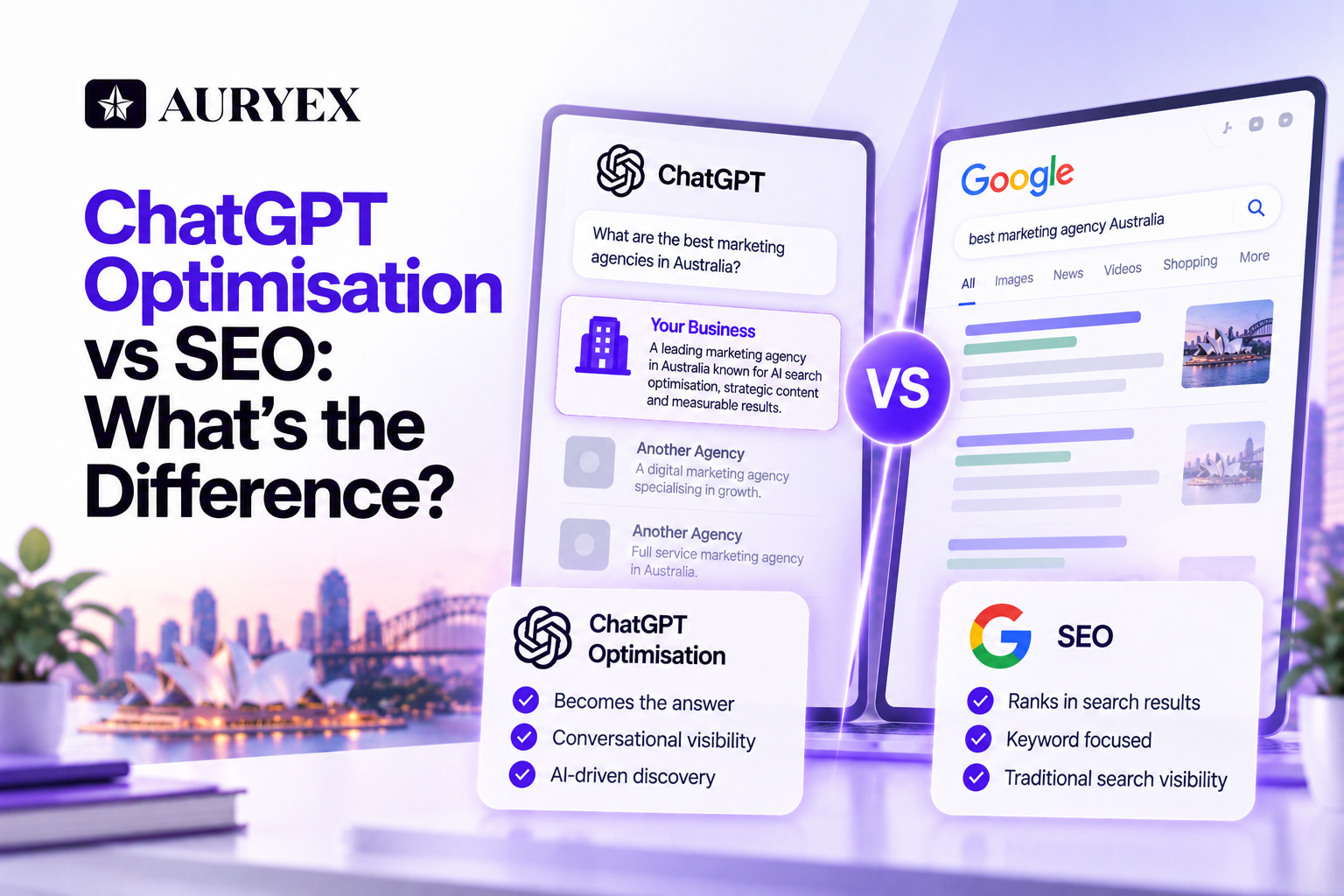
For years, businesses have focused on one major question: How can I rank higher on Google?
That question still matters. SEO remains one of the most important ways to attract organic traffic, build online authority, and reach people who are actively searching for products and services.
But search behaviour is changing. People are increasingly using AI tools such as ChatGPT to research businesses, compare products, understand complex topics, and find recommendations. Instead of clicking through several search results, a user can ask an AI tool a detailed question and receive a conversational response. This has created a new area of digital marketing often referred to as ChatGPT optimisation. So, how is ChatGPT optimisation different from SEO? Are they competing strategies? Does one replace the other? The short answer is no. SEO and ChatGPT optimisation have different primary focuses, but they work best together as part of a broader AI search and organic visibility strategy.What Is SEO?
SEO, or Search Engine Optimisation, is the process of improving a website so that it can perform better in traditional search engine results. SEO helps search engines understand your website and helps users discover your pages when they search for relevant information, products, or services. A typical SEO strategy can include:- Keyword research
- On-page optimisation
- Technical SEO
- Internal linking
- Content creation
- Link building
- Local SEO
- Website performance
- Structured data
- Search intent optimisation
What Is ChatGPT Optimisation?
ChatGPT optimisation focuses on making a brand’s information easier for AI systems to understand, interpret, and accurately represent in relevant AI-generated answers. Instead of focusing primarily on traditional rankings, the strategy considers how a business may appear when users ask conversational questions. For example:“Which AEO agencies in Australia should I consider for improving my AI search visibility?”The user may not receive a list of traditional search results. Instead, ChatGPT may provide a conversational answer based on the information and sources available within the particular AI search experience. ChatGPT optimisation therefore considers areas such as:
- Customer questions
- Conversational search intent
- Brand entities
- Topical authority
- Content quality
- Brand mentions
- Source credibility
- AI citations
- Business information consistency
- AI visibility monitoring
ChatGPT Optimisation vs SEO: The Main Difference
The simplest way to understand the difference is: SEO primarily aims to improve visibility in traditional search results, while ChatGPT optimisation focuses on how a brand can be understood and represented within AI-powered search and answer experiences. However, the two strategies overlap considerably. SEO builds the technical and content foundation. ChatGPT optimisation expands that foundation toward conversational discovery, entity understanding, AI visibility, and brand representation.SEO vs ChatGPT Optimisation
| Factor | SEO | ChatGPT Optimisation |
|---|---|---|
| Primary goal | Improve organic search visibility | Improve AI search visibility and brand understanding |
| Main environment | Search engines | AI-powered search and answer experiences |
| User behaviour | Keyword-based searches | Conversational questions |
| Content focus | Search intent and relevant topics | Questions, context, entities and useful answers |
| Key signals | Content, technical SEO, links, relevance | Content, entities, authority, mentions and source signals |
| Common metrics | Rankings, impressions, clicks, organic traffic | Mentions, citations, recommendations, source visibility and accuracy |
| User journey | Search → results → click | Question → AI response → further research |
| Optimisation style | Website and search-focused | Brand, content and AI-context focused |
How SEO Works
To understand why SEO and ChatGPT optimisation differ, it helps to look at how traditional SEO works. A simplified SEO journey looks like: Search query → Search engine processes query → Relevant pages are ranked → User chooses a result → Website visit Suppose someone searches: “Best AEO agency in Australia.” Search engines can return a collection of webpages that may include:- Agency websites
- Blog posts
- Business listings
- Reviews
- Directories
- Industry resources
How ChatGPT Optimisation Works
The AI search journey is different. A simplified version looks like: Conversational question → AI interprets intent → Relevant information is considered → Answer is generated → User continues the conversation For example, a user might ask:“I run a small Australian business. Do I need an AEO agency, and which type of agency should I look for?”The question contains more context than a typical keyword. AI can interpret the user’s intent and provide a conversational response. For brands, this creates a different visibility challenge. It is not only about ranking a webpage for a keyword. It is also about ensuring that the business has clear, credible, and relevant information available across its digital ecosystem.
Why Is ChatGPT Optimisation Becoming Important?
The biggest change is not simply the technology. It is how people ask questions. Traditional search often looks like: Keyword → Search results → Website AI-assisted search can look more like: Question → Answer → Follow-up question → Comparison → Recommendation → Decision A user may never start with a brand name. They may first ask about a problem. For example:“How can my company improve visibility in AI search?”Then:
“Should I hire an AEO agency?”And eventually:
“Which AEO agencies are worth considering?”This means brands need visibility throughout the customer’s question journey, not just for one commercial keyword.
Does SEO Still Matter for ChatGPT Optimisation?
Absolutely. ChatGPT optimisation does not make SEO obsolete. A technically strong website, well-organised content, clear internal linking, strong topical coverage, and good search visibility can all contribute to a stronger digital presence. SEO also helps businesses establish a foundation that supports broader search discovery. The better approach is not: SEO vs ChatGPT optimisation It is: SEO + AEO + ChatGPT optimisation + brand authority Each serves a different part of the modern search journey.Key Areas Where SEO and ChatGPT Optimisation Overlap
Despite their differences, SEO and ChatGPT optimisation share many fundamentals.Helpful Content
Both strategies benefit from content that genuinely answers user questions.Search Intent
Understanding why someone is searching remains important whether the user types a query or asks a conversational question.Topical Authority
Businesses should demonstrate expertise across relevant topics rather than publishing isolated pieces of content.Technical Accessibility
Search engines and AI-driven search experiences need access to understandable digital information.Internal Linking
A logical website structure helps connect related information and build topical relationships.Brand Authority
A trustworthy and recognisable brand has stronger foundations for both traditional and AI search visibility.Where ChatGPT Optimisation Goes Beyond Traditional SEO
While there is considerable overlap, ChatGPT optimisation introduces several additional considerations.1. Entity Understanding
SEO often focuses heavily on keywords and pages. AI search requires a broader understanding of who or what the business actually is. For example: Auryex → AEO agency → AI search visibility → Australia / USA / UK → Businesses The clearer these relationships are across a brand’s digital presence, the easier it can be for AI systems to interpret the business.2. Brand Mentions Beyond Your Website
Your website is not the only place where information about your brand exists. AI systems may encounter brand information through different sources and platforms. Relevant sources can include:- Industry publications
- Reviews
- Business directories
- Expert interviews
- Podcasts
- Partner websites
- News coverage
- Guest contributions
- Professional communities
3. Conversational Queries
SEO strategies often target keywords such as: AEO agency Australia ChatGPT optimisation also considers longer conversational questions such as: “What should an Australian business look for when choosing an AEO agency?” Both queries represent similar intent, but the second provides considerably more context.4. Answer Readiness
Content should be structured so that important questions can be answered clearly. Instead of burying the answer several paragraphs into a page, provide a concise explanation and then expand on it. This creates a better experience for both users and AI-driven search systems.SEO vs AEO vs ChatGPT Optimisation
These concepts are related but should not be treated as identical.| Strategy | Main Focus |
|---|---|
| SEO | Organic search visibility |
| AEO | Providing clear answers to user questions |
| GEO | Visibility in generative AI search experiences |
| ChatGPT Optimisation | Improving brand understanding and visibility in ChatGPT-related AI experiences |
- Use SEO to improve its website’s organic visibility.
- Use AEO to answer important customer questions.
- Use GEO principles to strengthen visibility across generative AI experiences.
- Monitor ChatGPT to understand how the brand is represented.
What Content Should You Create for SEO and ChatGPT Optimisation?
The strongest content strategy serves both traditional and AI search.Pillar Pages
Create comprehensive resources around your main services or topics. For example: AI Search Optimisation Guide Then create supporting pages covering:- AEO
- GEO
- ChatGPT optimisation
- AI citations
- AI brand tracking
- Conversational search
Question-Based Articles
Create content around genuine customer questions. Examples:- What is ChatGPT optimisation?
- How does ChatGPT optimisation work?
- Does SEO help with AI search?
- How can businesses improve AI search visibility?
- What is the difference between AEO and SEO?
Comparison Content
Comparison pages can help users who are evaluating solutions. Examples:- SEO vs AEO
- AEO vs GEO
- ChatGPT optimisation vs SEO
- Traditional search vs AI search
Case Studies and Expert Content
Demonstrate how strategies work in real situations. Include:- Processes
- Observations
- Data
- Examples
- Lessons learned
- Expert commentary
How to Optimise a Website for Both SEO and ChatGPT
You do not need two completely separate websites. Instead, build one strong digital foundation.Start With Search Intent
Understand what your audience searches for and asks.Build Topic Clusters
Create related content around your key subjects.Improve Technical SEO
Ensure important pages are accessible, crawlable, fast, and logically structured.Use Clear Headings
Organise content using descriptive H2s and H3s that reflect real questions and topics.Provide Direct Answers
Give users the answer quickly before expanding on the subject.Strengthen Entity Signals
Clearly explain your business, services, locations, expertise, and relationships.Build External Authority
Earn relevant mentions and references from credible sources.Monitor AI Visibility
Regularly test important customer questions across relevant AI platforms.How Do You Measure SEO vs ChatGPT Optimisation?
The metrics are not identical.SEO Metrics
Common SEO metrics include:- Organic traffic
- Keyword rankings
- Impressions
- Click-through rate
- Backlinks
- Indexed pages
- Conversions
- Search visibility
ChatGPT Optimisation Metrics
AI visibility can be monitored through metrics such as:- Brand mention rate
- AI recommendation rate
- Citation frequency
- Competitor visibility
- Brand accuracy
- Source visibility
- Visibility by customer question
- Visibility by location
Common Mistakes When Comparing SEO and ChatGPT Optimisation
Thinking ChatGPT Optimisation Replaces SEO
It does not. SEO remains an important part of a strong digital presence.Focusing Only on Keywords
AI search is highly contextual. Simply repeating a phrase such as “best AEO agency” is not a complete strategy.Publishing Large Volumes of Generic Content
More content does not automatically mean more authority. Useful, original, expert-led content is more valuable.Ignoring External Sources
Your website is only one part of your brand’s online identity.Expecting Guaranteed AI Recommendations
No ethical agency can guarantee that ChatGPT will recommend a particular business. The focus should be on improving relevance, credibility, and visibility.Should Your Business Invest in SEO or ChatGPT Optimisation?
For most businesses, the answer is both. SEO remains essential for capturing people who actively use traditional search engines. ChatGPT optimisation can help businesses adapt to customers who increasingly use AI to research and evaluate solutions. The right balance depends on:- Your industry
- Your target audience
- Your market
- Existing organic visibility
- Customer search behaviour
- Competition
- Business goals
How an AEO Agency Can Support Both Strategies
An experienced AEO agency can connect traditional SEO with emerging AI search strategies. Rather than treating SEO and AI visibility as completely separate campaigns, an agency can build a unified approach covering:- Keyword and question research
- Search intent
- Topic mapping
- Content optimisation
- Technical SEO
- Entity optimisation
- Internal linking
- Brand authority
- Digital PR
- AI prompt research
- AI visibility tracking
- Competitor analysis