
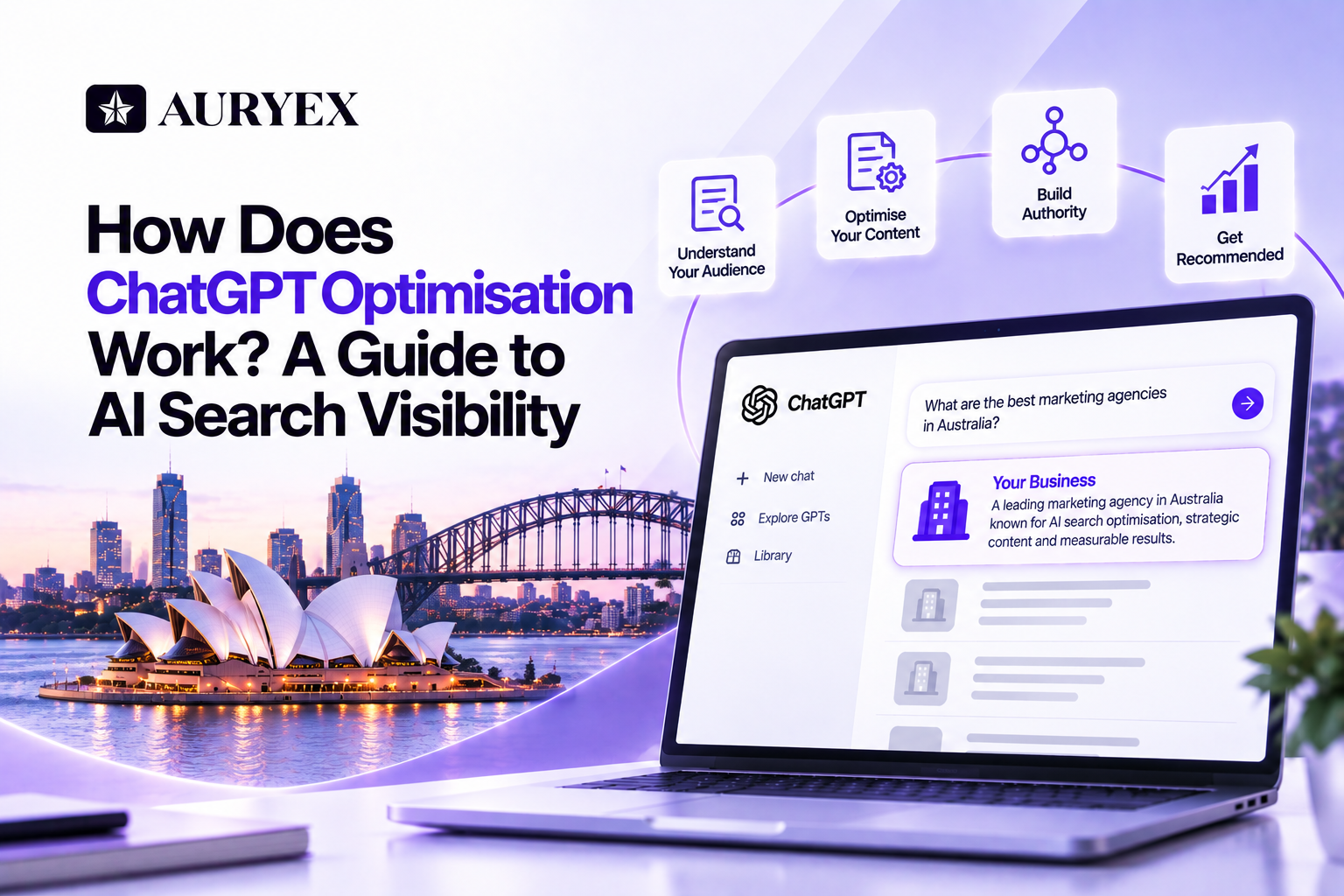
Search is no longer limited to traditional search engines. People are increasingly using AI platforms such as ChatGPT to ask questions, compare options, research businesses, and find solutions.
Instead of searching for ten different websites, a user can ask:
“What are the best AEO agencies for a business in Australia?”or:
“Which digital marketing agency can help improve my AI search visibility?”The answer may introduce the user to brands they were not previously familiar with. This shift has created a new digital marketing opportunity: ChatGPT optimisation. But how does ChatGPT optimisation actually work? Can businesses optimise their websites for ChatGPT? What signals matter for AI search visibility? This guide explains how ChatGPT optimisation works, how it differs from SEO and AEO, and what businesses can do to improve their chances of being understood and mentioned in AI-powered search experiences.
What Is ChatGPT Optimisation?
ChatGPT optimisation is the process of improving a brand’s content, online information, authority signals, and digital presence so AI systems can better understand and accurately represent the business in relevant answers. It is closely connected to Answer Engine Optimisation (AEO), Generative Engine Optimisation (GEO), and modern SEO. Rather than focusing only on ranking a webpage for a keyword, ChatGPT optimisation focuses on helping AI systems understand:- What your business does
- What products or services you offer
- Who your target audience is
- Where your business operates
- What topics you have expertise in
- How your brand compares with competitors
- Whether reliable sources support your claims
How Does ChatGPT Optimisation Work?
ChatGPT optimisation works by strengthening the signals that help AI systems understand a business, its expertise, its content, and its relevance to particular questions. A simplified process looks like this: Customer question → AI interprets intent → Relevant information is identified → Sources and entities are evaluated → AI generates an answer Depending on the AI experience and whether web/search capabilities are being used, the sources available to the system can differ. For businesses, this means there is no single “ChatGPT ranking factor” that guarantees visibility. Instead, effective optimisation involves several connected areas:- Understanding customer questions
- Creating useful answer-focused content
- Building topical authority
- Strengthening brand and entity signals
- Maintaining consistent business information
- Earning relevant third-party mentions
- Improving technical SEO
- Demonstrating genuine expertise
- Monitoring AI visibility
How Does ChatGPT Understand a Brand?
For a business to be represented accurately, AI systems need enough information to understand what the brand is and what it offers. Consider a company called Auryex. If its website consistently explains that it provides AEO, SEO, GEO, AI search optimisation, and AI visibility services, while relevant external sources discuss the same areas, the overall digital footprint creates a clearer picture of the business. This is known as entity understanding. Instead of viewing a brand as a collection of keywords, the goal is to establish a consistent relationship between: Brand → Services → Industry → Expertise → Location → Audience → Online sources The stronger and more consistent these relationships are, the easier it can be for AI systems to interpret the brand.What Factors Influence AI Search Visibility?
There is no universal public formula for AI search visibility. However, several areas are particularly important when building an AI search strategy.1. Search Intent and Customer Questions
AI search is highly conversational. Users may ask complete questions rather than entering short keywords. For example: Traditional search: “best AEO agency Australia” Conversational search: “Which AEO agency in Australia can help a B2B company improve its visibility across AI search?” The second query contains additional context. Businesses should therefore research the questions their customers ask before, during, and after making a purchase.Build Content Around Real Questions
Useful question categories include:- What is the service?
- How does it work?
- How much does it cost?
- What are the benefits?
- Which option is best?
- What are the alternatives?
- How does one provider compare with another?
- What should I consider before buying?
2. Helpful and Answer-Focused Content
Content remains one of the most important components of AI search visibility. However, simply publishing large amounts of content is not enough. Content should provide clear answers and useful context. A strong article should generally:- Answer the main question early
- Explain the topic clearly
- Use descriptive headings
- Cover relevant subtopics
- Provide examples
- Include original insights
- Address related questions
- Avoid unnecessary repetition
3. Topical Authority
AI systems need context to understand what a business is knowledgeable about. One article rarely establishes comprehensive expertise. Instead, businesses should develop topic clusters around their core services. For an AEO agency, a topical cluster could include:Core Topic
AEOSupporting Topics
- What is AEO?
- How does AEO work?
- AEO vs SEO
- AEO vs GEO
- AI search optimisation
- ChatGPT optimisation
- Google AI Overviews
- AI brand visibility
- LLM brand tracking
- AI citations
- AI search analytics
- Conversational search
4. Brand and Entity Signals
Traditional SEO often starts with keywords. AI search requires businesses to think more broadly about entities. An entity can be a person, company, organisation, place, product, or other clearly identifiable concept. For businesses, entity optimisation means making it clear:- Who you are
- What you do
- Where you operate
- Which services you provide
- Who you serve
- What industry you belong to
- What expertise you have
5. Consistent Information Across the Web
Your website is not the only place where AI systems may encounter information about your brand. Your digital footprint can include:- Business directories
- Review websites
- Social media
- Industry websites
- News publications
- Guest posts
- Partner websites
- Professional profiles
- Podcasts
- Interviews
- Business listings
6. Relevant Brand Mentions
AI search visibility is not only about your own website. Relevant third-party mentions can also contribute to your broader online presence. A brand may be mentioned in:- Industry publications
- Expert articles
- Interviews
- Podcasts
- Reviews
- Business directories
- Partner websites
- Digital PR campaigns
- Professional communities
7. First-Hand Expertise and Original Information
Generic content can make it difficult for a brand to stand out. Businesses should add information that demonstrates real experience. This could include:- Case studies
- Original research
- Expert commentary
- Data
- Real examples
- Industry observations
- Practical frameworks
- Processes
- Customer insights
- Author expertise
8. Technical SEO
ChatGPT optimisation does not replace technical SEO. A website still needs to be accessible, understandable, and technically sound. Important areas include:- Crawlability
- Indexability
- Site architecture
- Internal linking
- Mobile usability
- Page speed
- Descriptive URLs
- Metadata
- Structured content
- Appropriate schema markup
- Clear navigation
How Does AEO Fit Into ChatGPT Optimisation?
Answer Engine Optimisation (AEO) focuses on creating content and information that can effectively answer user questions across answer-driven search experiences. ChatGPT optimisation can be considered part of a broader AEO and AI search strategy. For example: SEO → Helps improve traditional search visibility. AEO → Focuses on providing clear answers to user questions. GEO → Focuses on visibility within generative AI experiences. ChatGPT optimisation → Focuses specifically on improving how a brand can be understood and represented within ChatGPT-related AI search experiences. These strategies overlap considerably. Businesses do not necessarily need completely separate strategies for every AI platform.ChatGPT Optimisation vs Traditional SEO
| Traditional SEO | ChatGPT Optimisation |
|---|---|
| Focuses heavily on search rankings | Focuses on AI visibility and brand understanding |
| Targets keywords and search queries | Targets questions and conversational prompts |
| Measures rankings and organic traffic | Can measure mentions, citations and recommendations |
| Optimises webpages for search engines | Optimises information for AI-driven discovery |
| Strong technical SEO foundation | Strong entity, content and authority signals |
| Traditional search journey | Conversational AI-assisted journey |
What Types of Content Should You Create for ChatGPT Optimisation?
Different content formats can support AI search visibility.Informational Blog Posts
Answer questions your potential customers ask. Examples:- What is AEO?
- How does ChatGPT optimisation work?
- What is GEO?
- How can businesses improve AI search visibility?
Comparison Content
Comparison pages can help users evaluating different options. Examples:- SEO vs AEO
- AEO vs GEO
- Traditional search vs AI search
- Agency vs in-house AEO
Service Pages
Clearly explain:- What you offer
- Who you help
- What problems you solve
- Where you operate
- Why your approach is different
FAQ Content
Use genuine customer questions and provide direct, useful answers.Case Studies
Demonstrate how your process works through real examples and measurable outcomes where appropriate.Expert Guides
Create comprehensive resources that demonstrate genuine expertise in your field.How to Optimise a Website for ChatGPT and AI Search
A practical optimisation process can be divided into several steps.Step 1: Research Your Audience
Identify the questions customers ask before choosing your product or service. Use:- Customer conversations
- Search queries
- FAQs
- Sales questions
- Reddit discussions
- Community discussions
- Competitor content
- Search suggestions
Step 2: Build a Question Map
Organise questions according to search intent. For example:Informational Intent
“What is AEO?”Commercial Intent
“What does an AEO agency do?”Comparison Intent
“AEO vs SEO: which is better?”Transactional Intent
“How do I hire an AEO agency?” This creates a structured content strategy.Step 3: Build Topic Clusters
Create a central pillar page supported by related articles. Connect these pages with relevant internal links.Step 4: Improve Brand Entity Signals
Make your business information clear and consistent across your website and important external platforms.Step 5: Strengthen External Authority
Earn relevant mentions, reviews, citations, expert references, and digital PR coverage where appropriate.Step 6: Improve Technical SEO
Make sure your website is crawlable, indexable, fast, mobile-friendly, and logically structured.Step 7: Monitor AI Visibility
Test relevant prompts across AI search platforms and record how your brand appears. Then identify:- Missing mentions
- Incorrect information
- Competitor visibility
- Frequently cited sources
- Content gaps
- Changes over time
How to Measure ChatGPT Optimisation Results
AI search visibility should not be measured using a single metric. Instead, track several indicators.Brand Mention Rate
How frequently does your brand appear for relevant prompts?Recommendation Rate
How often is your business included when users ask for recommendations?Citation Visibility
When relevant, which sources are associated with AI-generated answers about your industry or brand?Competitor Visibility
Which competitors appear more frequently than your brand?Brand Accuracy
Does AI describe your business correctly?Geographic Visibility
Does your brand appear for relevant queries in the markets you serve?Customer Intent Visibility
Does your brand appear for informational, commercial, comparison, and transactional prompts? AI responses can change based on prompts, location, context, available information, and platform updates, so measurements should be treated as directional rather than permanent rankings.Common ChatGPT Optimisation Mistakes
Focusing Only on Keywords
Keyword optimisation remains useful, but AI search requires broader context.Publishing Large Amounts of Generic Content
More content does not automatically mean more visibility. Focus on relevance, usefulness, expertise, and originality.Ignoring External Brand Signals
Your website is only one part of your digital identity.Creating Content Only for AI
Content should primarily be useful to people. Optimising for AI should not make the experience unnatural.Expecting Instant Results
AI search visibility can take time to develop, particularly when a brand has limited authority or online presence.Trying to Guarantee AI Recommendations
No legitimate AEO strategy can guarantee that ChatGPT or another AI platform will recommend a particular business for every relevant query.How an AEO Agency Can Help With ChatGPT Optimisation
Building AI search visibility requires more than publishing a few blog posts. An experienced AEO agency can help with:- AI search research
- Customer-question mapping
- Content strategy
- Topic clusters
- Entity optimisation
- On-page SEO
- Technical SEO
- Brand visibility tracking
- Competitor monitoring
- Citation analysis
- Digital PR and authority building
- Local AI search optimisation