
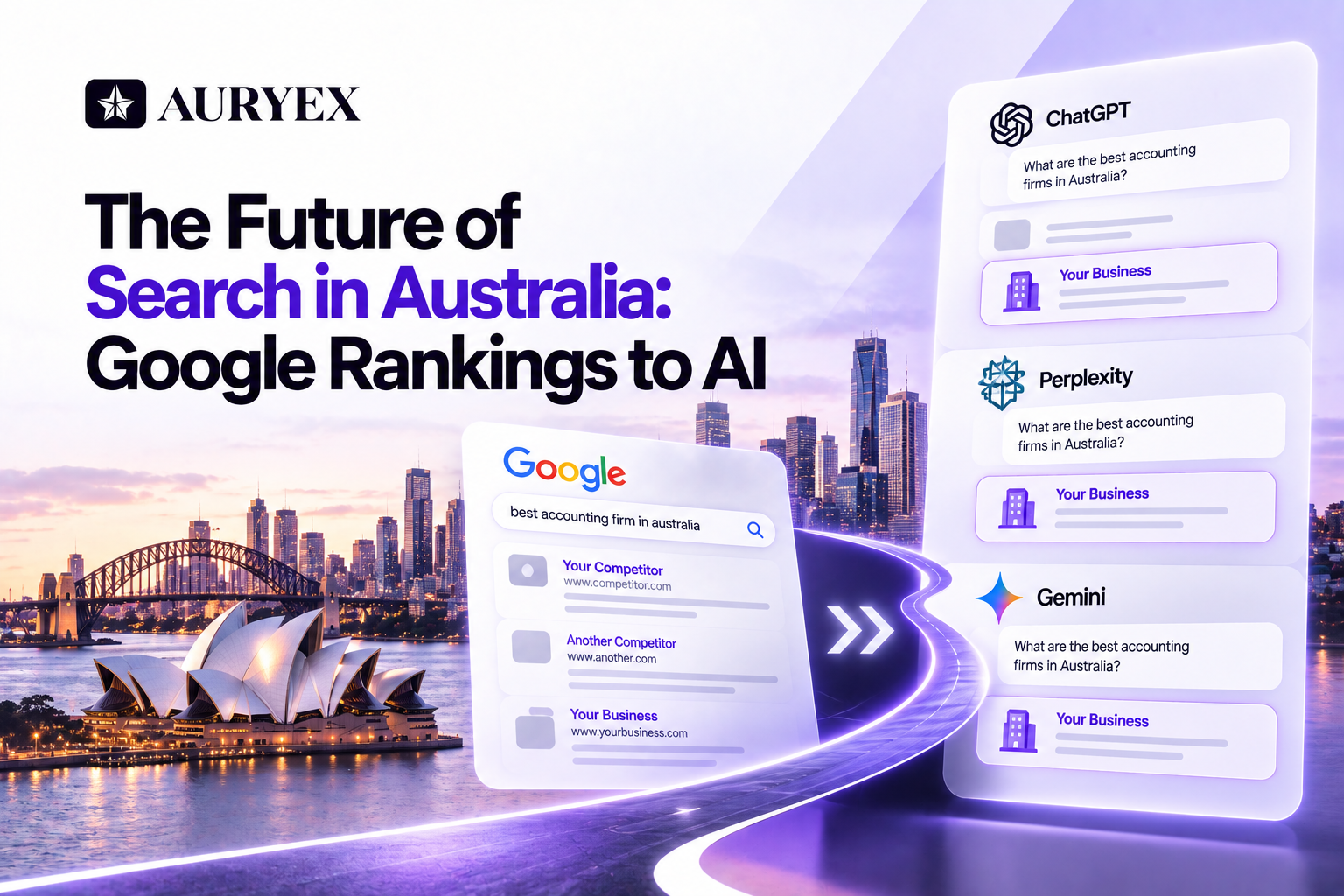
For years, Australian businesses have focused on one major goal in search: ranking higher on Google.
Businesses invested in SEO, optimized their websites, built backlinks, created content, and tracked keyword positions to attract Australian customers.
But the way people discover businesses is changing. Instead of searching only through traditional search engines, consumers can now ask AI platforms questions such as:- “What are the best digital marketing agencies in Australia?”
- “Which AEO agency should an Australian business consider?”
- “What are the best accounting firms in Sydney?”
- “Which restaurants are recommended near Melbourne CBD?”
- “How can I improve my business visibility in AI search?”
How Search Is Changing in Australia
Traditional search generally follows a familiar process: Search query → Google results → Website visit → Comparison → Decision AI-powered search can shorten this journey: Question → AI-generated answer → Recommendations → Sources → Decision For example, someone looking for an AEO agency in Australia might previously search Google for:“AEO agency Australia”They may now ask an AI platform:
“Which AEO agencies in Australia can help improve my visibility in AI search?”The AI may provide an explanation, mention several businesses, summarize their services, and potentially provide sources. This changes what businesses need to optimize for. Instead of focusing exclusively on: “How do I rank for this keyword?” businesses increasingly need to ask: “How can my brand become a relevant and trustworthy source for this question?”
What Is AI Search?
AI search refers to search experiences that use artificial intelligence to understand questions and generate responses rather than simply presenting a list of links. Platforms such as ChatGPT, Perplexity, Gemini, and other AI-powered search experiences can understand conversational questions and provide synthesized answers. For businesses, this means search visibility is no longer limited to traditional blue-link rankings. Your business might be:- Mentioned in an AI answer
- Cited as a source
- Included in a comparison
- Recommended for a specific need
- Referenced through third-party content
- Used as a source of business information
Will Google Rankings Become Irrelevant?
No. Google search remains an important part of online discovery, and traditional SEO continues to matter. Websites still need:- Strong technical SEO
- Relevant content
- Good user experience
- Search visibility
- Authority
- Internal linking
- Quality backlinks
- Local SEO where relevant
From Rankings to Recommendations
One of the biggest changes brought by AI search is the growing importance of recommendations. A traditional search query might produce:- Website A
- Website B
- Website C
- Website D
“If you’re looking for an AEO agency in Australia, here are several agencies to consider based on their services and focus.”This creates a different type of visibility. A business doesn’t necessarily need to be presented as a numbered ranking to gain exposure. It may simply need to be relevant enough to appear within the answer. This is where Answer Engine Optimization (AEO) becomes increasingly important.
What Is AEO?
Answer Engine Optimization, or AEO, is the process of optimizing a brand’s content and online presence so that it can better answer the questions people ask across search engines and AI-powered answer experiences. Traditional SEO often focuses on keywords and rankings. AEO focuses more heavily on:- Questions
- Direct answers
- Search intent
- Context
- Structured information
- Topical authority
- Brand understanding
- Entity signals
- What is an AEO agency?
- How does AEO work?
- How can AEO help Australian businesses?
- What does an AEO agency do?
- How much does AEO cost in Australia?
- How is AEO different from SEO?
- How can a business appear in AI search?
SEO vs AEO vs GEO
SEO, AEO, and GEO are related but have different areas of focus.| Strategy | Main Focus | Example |
|---|---|---|
| SEO | Traditional search visibility | Ranking on Google |
| AEO | Answer visibility | Appearing in answers to customer questions |
| GEO | Generative AI visibility | Improving brand representation in AI-generated responses |
Why Australian Businesses Should Care About AI Recommendations
Australian businesses operate in an increasingly competitive digital environment. Whether you’re an agency in Sydney, a professional service provider in Melbourne, an ecommerce business in Brisbane, or a local business in Perth, customers increasingly have multiple ways to research their options. AI recommendations can become relevant during several stages of this journey.During initial research
A customer may ask:“What companies provide SEO services in Australia?”
During comparison
They might ask:“Compare SEO and AEO agencies for a small Australian business.”
During decision-making
They may ask:“What should I look for when choosing an AEO agency?”This means businesses need to provide useful information across different stages of the customer journey.
AI Search Is More Conversational
Traditional searches are often short. For example: “AEO agency Australia” Conversational AI searches can be much longer:“I’m a small business owner in Sydney. How can I improve my visibility when customers use AI tools to find local services?”The second query provides significantly more context. AI systems can use that context to generate a response based on the user’s specific situation. For businesses, this means content should not focus exclusively on short keywords. It should also answer real customer questions in natural language.
What Does AI Need to Understand About Your Business?
If you want your brand to be represented accurately in AI search, AI systems need enough reliable information to understand what your business actually does. Important signals can include:Your services
Clearly explain what you offer and who you serve.Your location
For Australian businesses, clearly communicate relevant locations such as Sydney, Melbourne, Brisbane, Perth, Adelaide, or nationwide service areas where applicable.Your expertise
Publish useful information demonstrating knowledge in your industry.Your brand identity
Maintain consistent business information across your website and relevant third-party platforms.Your customer focus
Explain which audiences, industries, or use cases your services are designed for.External references
Relevant third-party mentions can provide additional context about your business. The objective isn’t to manipulate AI systems into recommending a brand. The goal is to make your business clear, relevant, credible, and easy to understand.The Importance of Topical Authority
One page rarely explains everything a potential customer needs to know. For example, an Australian AEO agency could create content around:- What is AEO?
- AEO vs SEO
- AEO vs GEO
- AI search optimization
- AI brand visibility
- How to track AI mentions
- AEO services
- AEO pricing
- AEO strategy
- AI search trends in Australia
Local Search Is Also Changing
AI search isn’t limited to national businesses. Local businesses can also be affected. Consider a customer asking:“Where can I find a good family restaurant in Melbourne?”or:
“Which accounting firms in Sydney specialize in small businesses?”The answer may depend on:
- Location
- Business information
- Reviews
- Website content
- Local listings
- Relevant third-party sources
- Customer intent
Online Brand Mentions Matter
AI systems don’t only rely on your website. Information about a company can exist across the wider web. This may include:- Industry publications
- Business directories
- Reviews
- News websites
- Partner websites
- Interviews
- Industry blogs
- Social profiles
How Australian Businesses Can Prepare for AI Search
Preparing for AI search doesn’t require abandoning traditional SEO. Instead, businesses can expand their existing strategy.1. Build Content Around Real Questions
Research what customers actually ask. Then create clear, useful answers. Don’t write content simply because a keyword has search volume. Consider the underlying problem behind the search.2. Strengthen Topical Coverage
Cover the important subjects surrounding your products and services. A comprehensive topic ecosystem gives customers—and search systems—more information to work with.3. Make Your Brand Easy to Understand
Clearly communicate:- What you do
- Who you serve
- Where you operate
- What makes your service relevant
- What expertise you have
4. Maintain Consistent Business Information
Review your website, business profiles, directories, and other relevant online references. Inconsistent information can make your digital presence harder to interpret.5. Improve Technical SEO
AI visibility doesn’t eliminate the fundamentals. Make sure your website remains:- Crawlable
- Fast
- Mobile-friendly
- Well-structured
- Internally linked
- Accessible to search engines
6. Develop Helpful, Original Content
AI search doesn’t remove the need for quality content. If anything, useful first-hand information, expertise, examples, data, and clear explanations can become even more valuable.7. Monitor AI Visibility
Test relevant questions across AI platforms and record:- Brand mentions
- Citations
- Recommendations
- Competitors
- Sources
- Brand descriptions
How Do You Measure AI Search Visibility?
Traditional SEO has familiar metrics such as:- Keyword rankings
- Organic traffic
- Click-through rate
- Impressions
- Backlinks
Brand Mention Rate
How frequently does your brand appear across a defined set of relevant prompts?Citation Visibility
How often is your website or another source about your business referenced?Recommendation Presence
How often does your business appear when users ask for relevant providers or solutions?Competitor Mentions
Which competitors appear for the same questions?Brand Accuracy
Is your company being described correctly?Referral Traffic
Are AI-related visitors reaching your website? These metrics can provide a broader picture than traditional keyword rankings alone.AI Recommendations Are Not Guaranteed
It’s important to understand that AI recommendations aren’t equivalent to fixed Google rankings. AI responses can vary based on:- The wording of the prompt
- Location
- User context
- Available sources
- Freshness of information
- Platform
- Model updates
- Search features
The Future of Search in Australia
The future of search is unlikely to be defined by one platform. Google will continue to be important. AI platforms will continue to develop. Consumers will continue to use social platforms, maps, reviews, websites, marketplaces, and other digital channels to research businesses. The result is a more fragmented but also more conversational discovery environment. Australian businesses that prepare for this change can build visibility across multiple stages of the customer journey. The question is no longer only: “Where does my website rank?” It is increasingly: “How does my brand appear when customers ask questions about what I offer?” That is a much broader approach to search visibility.How an AEO Agency Can Help
An experienced AEO agency can help businesses adapt their existing SEO strategy for AI-powered search. This can involve:- AI search research
- Customer question mapping
- AEO content strategy
- GEO optimization
- Entity and brand optimization
- Topical authority development
- Local AI search optimization
- AI visibility tracking
- Competitor analysis
- Citation monitoring
- Content gap analysis
- Ongoing performance reporting