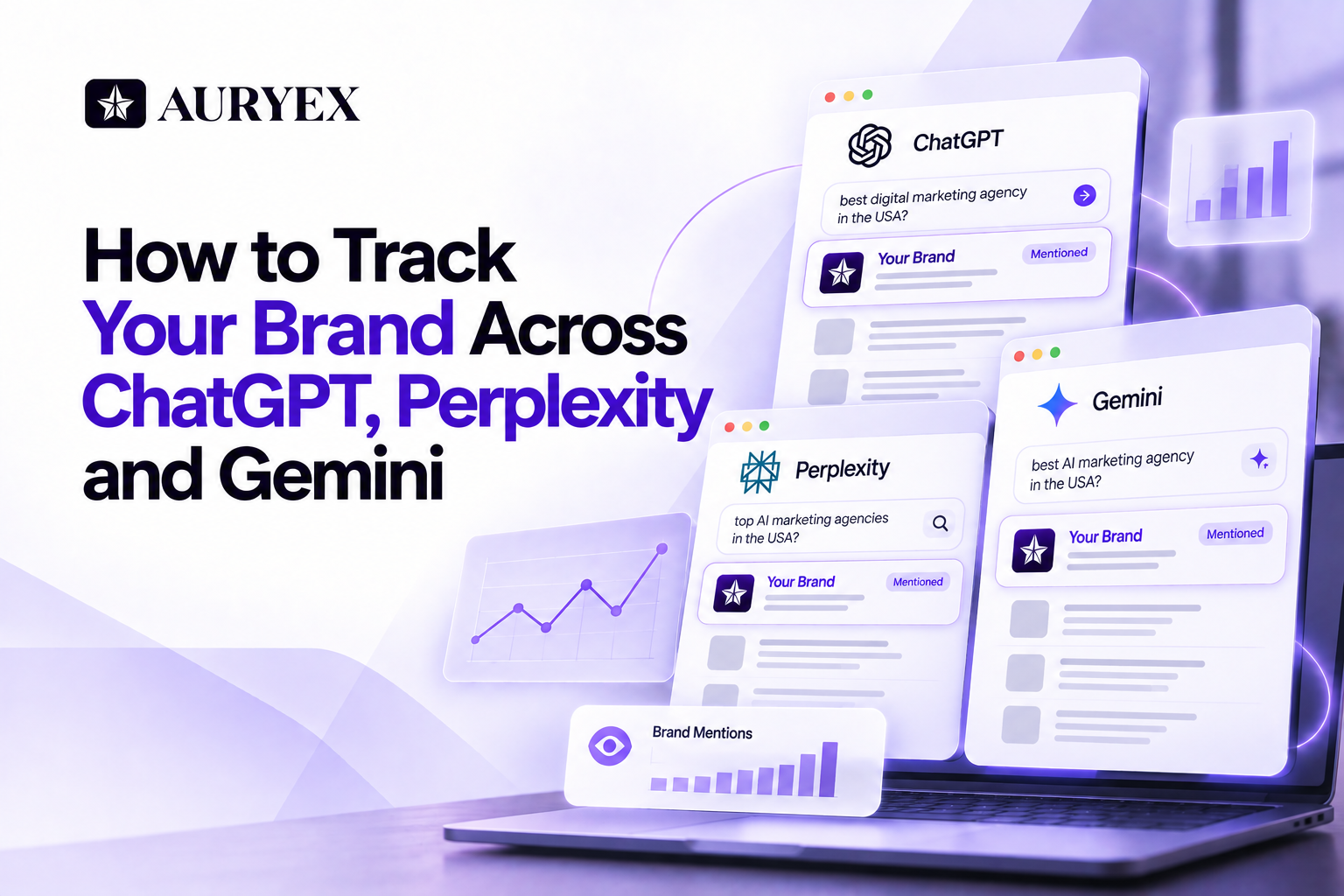
For years, businesses tracked their online visibility by monitoring Google rankings, organic traffic, backlinks, and conversions.
But search is changing.
People now ask AI platforms questions such as:
- “What are the best digital marketing agencies in Australia?”
- “Which AEO agencies can help a US business?”
- “What companies offer Answer Engine Optimization?”
- “Which agency should I consider for improving AI search visibility?”
The answer may come from ChatGPT, Perplexity, Gemini, or another AI-powered search experience rather than a traditional search results page.
This creates a new challenge for businesses: How do you know whether your brand is being mentioned, cited, or recommended by AI?
Tracking AI visibility requires a different approach from traditional rank tracking. Instead of checking where your website ranks for a keyword, you need to understand how AI systems represent your brand across different prompts, locations, sources, and conversations.
This guide explains how businesses can track their brand across ChatGPT, Perplexity, and Gemini and what metrics actually matter.
What Does It Mean to Track Your Brand in AI Search?
AI brand tracking means monitoring how your business appears in AI-generated answers when people ask questions related to your products, services, industry, or competitors.
Your brand may appear in several ways.
For example, an AI platform might:
- Mention your company by name
- Recommend your business
- Cite your website
- Reference one of your articles
- Compare you with competitors
- Describe your services
- Use information from third-party websites about your company
- Exclude your brand entirely from relevant answers
This is different from traditional SEO.
With Google, you might track:
Keyword → Position → Click → Traffic
With AI search, the journey can look more like:
Prompt → AI answer → Brand mention → Citation → Website visit → Conversion
That makes AI visibility more contextual and less dependent on a single ranking position.
Why Should Businesses Track AI Brand Visibility?
AI platforms are becoming part of the research and discovery process.
A potential customer may use AI to create a shortlist before visiting individual websites. If your business is absent from these conversations, you may miss visibility at an important stage of the buying journey.
Tracking can help you understand:
1. Whether AI systems know your brand
You can identify whether ChatGPT, Perplexity, or Gemini recognizes your business and understands what you offer.
2. How your brand is described
A business may be mentioned but described incorrectly or incompletely.
For example, an AI response might identify a company as a general marketing agency when its actual focus is AEO, SEO, or AI search optimization.
3. Which questions trigger your brand
Your business may appear for some prompts but not others.
This helps identify areas where your content and online presence may have stronger or weaker visibility.
4. Which sources influence AI answers
AI platforms can rely on websites, publications, directories, reviews, and other online sources.
Tracking citations can help you identify which sources are associated with your brand’s visibility.
5. How competitors appear
You can also monitor whether competitors are being mentioned for prompts where your brand is absent.
The goal isn’t simply to copy competitors. Instead, competitor visibility can reveal topics, questions, and sources that deserve further investigation.
How to Track Your Brand Across ChatGPT
ChatGPT can be used for conversational research, recommendations, comparisons, and questions about businesses.
However, AI responses can vary depending on the prompt, conversation context, available web information, location, and system updates.
Therefore, don’t rely on one prompt.
Step 1: Create a Prompt List
Start by creating a list of questions your potential customers might ask.
For example, an AEO agency could track prompts such as:
- “What is an AEO agency?”
- “Which AEO agencies serve Australian businesses?”
- “How can a business improve visibility in AI search?”
- “What does an AEO agency do?”
- “What are the best AEO services for a small business?”
- “Compare AEO and SEO agencies.”
- “How can I improve my brand’s visibility in ChatGPT?”
These prompts should represent different stages of the customer journey.
Step 2: Record Brand Mentions
For each prompt, record whether your brand:
- Appeared
- Was recommended
- Was mentioned but not recommended
- Was cited as a source
- Was compared with another business
- Was not mentioned
This creates a basic AI visibility baseline.
Step 3: Check Different Prompt Variations
Don’t search the same question repeatedly.
Test variations involving:
- Different wording
- Different locations
- Different customer needs
- Different industries
- Different service categories
- Competitor comparisons
For example:
“What are the best AEO agencies?”
could be tested alongside:
“Which AEO agencies help Australian businesses improve AI search visibility?”
The answers may differ.
How to Track Your Brand Across Perplexity
Perplexity has a strong focus on web-based answers and citations, making source visibility particularly useful to monitor.
When tracking your brand, pay attention to both mentions and citations.
For example, check whether Perplexity:
- Mentions your company
- Links to your website
- Cites your blog posts
- Uses third-party sources describing your company
- References review or directory pages
- Includes competitors instead of your brand
Track Citation Sources
Suppose your brand appears in an answer and Perplexity cites a particular industry publication.
That source becomes useful information.
It may indicate that the publication provides information that contributes to how your brand is represented in AI search.
Over time, you can build a list of sources associated with your brand:
| Source Type |
What to Track |
| Your website |
Pages cited or referenced |
| Industry publications |
Brand mentions |
| Business directories |
Company information |
| Review platforms |
Customer perception |
| News websites |
Brand coverage |
| Partner websites |
Relevant mentions |
| Industry blogs |
Expertise and references |
The objective is not to generate artificial mentions. It is to build a trustworthy and consistent online presence that AI systems can understand.
How to Track Your Brand Across Gemini
Google’s Gemini can also be used for questions about businesses, products, services, and industries.
The tracking process is similar, but the exact experience and information presented can vary by product version, location, query, and available search features.
Create a dedicated set of prompts relevant to your audience.
For example:
“What are some AEO agencies in Australia?”
Then test related questions:
“How does AEO help Australian businesses?”
“What should I look for when choosing an AEO agency?”
“Which agencies specialize in AI search visibility?”
Record whether your brand appears and how it is represented.
Create an AI Brand Visibility Tracking Sheet
One of the easiest ways to start tracking AI visibility is with a spreadsheet.
You don’t need complicated software at the beginning.
A basic tracking sheet can include:
| Date |
Platform |
Prompt |
Brand Mention |
Recommendation |
Citation |
Competitors Mentioned |
Notes |
| Sept 2026 |
ChatGPT |
AEO agencies in Australia |
Yes |
Yes |
Yes |
Brand A |
Mentioned as an AEO provider |
| Sept 2026 |
Perplexity |
AEO services Australia |
Yes |
No |
Yes |
Brand B |
Website cited |
| Sept 2026 |
Gemini |
AI search agencies |
No |
No |
No |
Brand A |
Competitors appeared |
The important part is consistency.
Run the same core prompts periodically so you can compare changes over time.
What AI Visibility Metrics Should You Track?
Brand mentions alone aren’t enough.
A useful AI visibility measurement framework should include several metrics.
1. Brand Mention Rate
Measure how often your brand appears across a defined set of relevant prompts.
For example:
Brand Mention Rate = Prompts With Brand Mention ÷ Total Prompts Tested × 100
This provides a simple way to establish a baseline.
2. Citation Rate
Track how often your website or other trusted sources about your brand are cited.
A brand can be mentioned without its website being cited, so these are different measurements.
3. Recommendation Rate
Track how frequently the AI response recommends or includes your business when the prompt asks for relevant providers.
This should be measured carefully because recommendations can change between prompts and sessions.
4. Competitor Visibility
Record which competitors appear alongside or instead of your business.
You can then identify patterns such as:
- Competitors appearing for more prompts
- Competitors being cited more frequently
- Competitors appearing for specific locations
- Competitors being associated with particular services
5. Source Visibility
Identify which websites are repeatedly appearing as sources.
This can help you understand the wider information ecosystem surrounding your industry.
6. Brand Accuracy
This metric is often overlooked.
Ask:
Is the AI describing my business correctly?
Check information such as:
- Services
- Locations
- Industry
- Target audience
- Specializations
- Company positioning
An increase in mentions isn’t necessarily useful if the information is inaccurate.
Track AI Visibility by Location
AI answers can vary based on geographic context.
A business targeting Australia shouldn’t only test generic prompts.
Instead, create location-specific prompts such as:
- “AEO agencies in Australia”
- “AEO services for Australian businesses”
- “AI search optimization agencies in Sydney”
- “How can Australian businesses improve AI search visibility?”
A US-focused business could test:
- “AEO agencies in the USA”
- “AEO companies for US businesses”
- “AI search optimization agencies in New York”
- “How can US businesses appear in AI search?”
This is particularly important for local and regional businesses.
Track Different Types of Customer Questions
Another useful approach is to organize prompts according to the customer journey.
Informational
“What is AEO?”
Problem-focused
“How can I improve my visibility in AI search?”
Commercial
“What does an AEO agency do?”
Comparison
“AEO agency vs SEO agency — what’s the difference?”
Transactional
“How do I choose an AEO agency?”
Local
“Which AEO agencies work with Australian businesses?”
This gives you a broader picture of how your brand performs throughout the discovery journey.
Don’t Focus Only on Being Recommended
One of the biggest mistakes in AI visibility tracking is treating recommendations as the only goal.
AI systems can mention a company for many reasons.
Your brand might appear because:
- Your website contains relevant information
- A publication mentions your company
- An industry website references your work
- A directory has your business details
- Your content answers a specific question
- Your brand has established online entity signals
Therefore, tracking why and where your brand appears can be more useful than simply counting recommendations.
How SEO, AEO and GEO Fit Into AI Brand Tracking
AI visibility doesn’t replace traditional SEO.
Instead, SEO, AEO, and GEO address different parts of modern search.
| Strategy |
Primary Focus |
What You Track |
| SEO |
Search engine visibility |
Rankings, organic traffic, clicks |
| AEO |
Direct answers |
Answer visibility, question coverage, mentions |
| GEO |
Generative AI visibility |
AI mentions, citations, representation |
| AI Brand Tracking |
Brand presence across AI |
Mentions, citations, recommendations, accuracy |
A strong strategy can combine all four perspectives.
SEO helps make your website discoverable.
AEO helps structure information around the questions people ask.
GEO focuses on how your brand and content can be represented in generative search environments.
AI brand tracking helps you understand what is actually happening.
What If Your Brand Doesn’t Appear?
Don’t immediately assume that your website needs more content.
First, investigate the potential reasons.
Your brand may have:
- Limited topical authority
- Weak brand/entity signals
- Inconsistent business information
- Little third-party coverage
- Content that doesn’t directly answer customer questions
- Limited relevant online references
- Technical SEO issues
- Poor coverage of important customer questions
The solution depends on the underlying issue.
For example, publishing 50 additional blog posts may not solve a brand authority problem if those articles don’t add useful information or strengthen your topical relevance.
How Often Should You Track AI Visibility?
There isn’t one universal schedule.
For most businesses, a practical approach is to establish a baseline first and then monitor the same important prompts periodically.
For example:
Baseline → Monthly monitoring → Quarterly deeper analysis
During deeper reviews, you can expand the prompt set and investigate:
- New competitors
- New customer questions
- New citations
- Changes in brand descriptions
- New AI search experiences
- Changes in visibility by location
The important thing is to compare like with like.
If your prompts change every month, it becomes difficult to determine whether visibility actually changed.
Common AI Brand Tracking Mistakes
Checking Only One AI Platform
ChatGPT, Perplexity, and Gemini may produce different results.
Tracking all three provides a broader view.
Using Only One Prompt
A single prompt doesn’t represent your entire customer journey.
Build a prompt library instead.
Tracking Mentions Without Context
A brand mention isn’t automatically positive or useful.
Record how the brand was mentioned.
Ignoring Citations
Citations can reveal which sources are contributing to AI-generated answers.
Tracking Only Competitors
Competitor monitoring is useful, but your primary focus should remain on your own visibility, accuracy, and customer questions.
Expecting Stable Results
AI responses can change based on context, location, data sources, model updates, and other factors.
Your tracking process should therefore identify trends rather than treating one response as a permanent ranking.
Can an AEO Agency Help Track AI Brand Visibility?
Yes. An AEO agency can help build a structured AI visibility strategy around your business.
This can include:
- Customer prompt research
- AI visibility baselines
- ChatGPT, Perplexity, and Gemini monitoring
- Brand mention tracking
- Citation analysis
- Competitor visibility analysis
- Content gap analysis
- Entity and brand optimization
- Topical authority development
- Local AI search optimization
- Ongoing reporting
For businesses investing in AEO, the value isn’t simply knowing whether a brand appeared in one AI response.
The bigger objective is understanding how consistently and accurately the brand is represented across relevant AI search journeys.
Auryex helps businesses approach AI search visibility through a combination of SEO, AEO, GEO, content, and brand-focused strategies. The focus is on understanding how customers search and how brands can build stronger signals across the wider digital ecosystem.
Final Thoughts
AI is creating a new layer of brand discovery.
Customers can ask ChatGPT, Perplexity, Gemini, and other AI tools for recommendations, comparisons, explanations, and solutions without following the traditional search journey.
That means businesses need to look beyond traditional keyword rankings.
Start by creating a list of realistic customer prompts. Test your brand across multiple AI platforms, track mentions and citations, monitor competitors, check the accuracy of your brand information, and measure changes over time.
Most importantly, don’t treat AI visibility as a fixed ranking.
Track patterns, understand the sources behind your visibility, and continuously improve the information available about your brand.
As AI-powered discovery becomes a larger part of the customer journey, understanding where and how your brand appears can become an important part of modern SEO and AEO strategy.
Frequently Asked Questions
Q: How can businesses track their brand across ChatGPT, Perplexity, and Gemini?
Ans: Create a consistent list of customer-focused prompts, test them across each AI platform, and record brand mentions, recommendations, citations, competitors, and how the brand is described.
Q: What AI visibility metrics should businesses track?
Ans: Key metrics include brand mention rate, citation rate, recommendation rate, competitor visibility, source visibility, and brand accuracy. Tracking these over time provides a clearer picture of AI search performance.
Q: How often should businesses monitor AI brand visibility?
Ans: A practical approach is to establish a baseline, monitor important prompts monthly, and conduct a deeper analysis quarterly. Keeping the core prompts consistent makes changes easier to measure.