
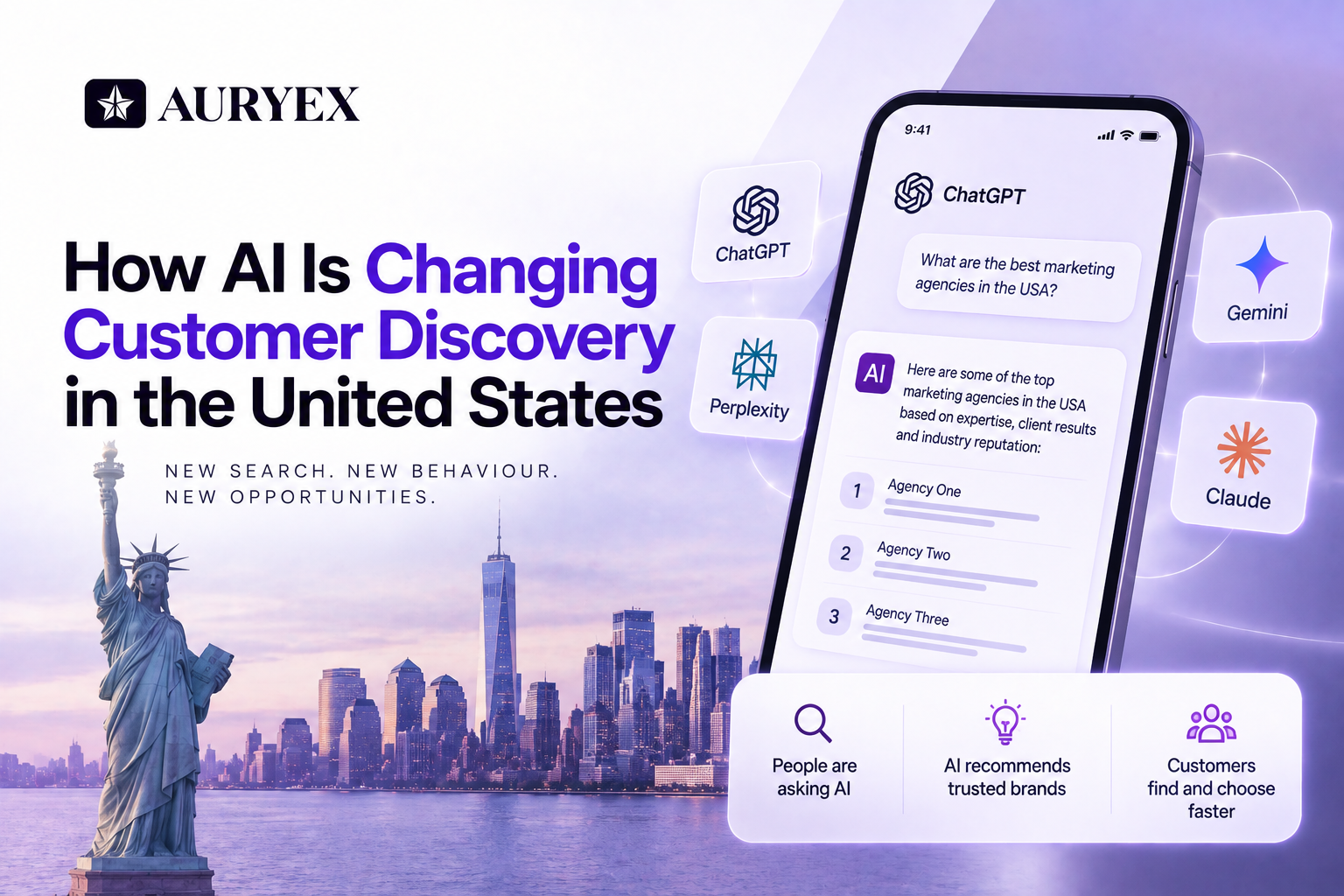
For years, the customer discovery journey in the United States followed a fairly familiar path.
Someone had a problem, opened Google, searched for a product or service, compared several websites, read reviews, and eventually made a decision.
Today, that journey is changing. Consumers can ask AI-powered platforms questions in natural language and receive summaries, comparisons, recommendations, and follow-up answers in seconds. Instead of searching: “best digital marketing agency in New York” a potential customer might ask:“What should I look for when choosing a digital marketing agency in New York for a growing e-commerce business?”That’s more than a keyword search. It’s a customer discovery question. And as AI becomes part of the research process, businesses in the United States need to understand how customers are discovering brands, evaluating options, and making decisions. This is where AI search, AEO, and GEO are becoming increasingly important.
What Is Customer Discovery?
Customer discovery is the process through which people become aware of businesses, products, services, and solutions that could meet their needs. Traditionally, this might involve:- Searching on Google
- Visiting several websites
- Comparing products or services
- Reading reviews
- Asking friends or colleagues
- Checking social media
- Making a purchase or contacting a business
How AI Is Changing Search Behaviour in the US
Search behaviour is becoming more conversational. People don’t always need to think about the exact keywords they should type. They can simply describe what they want. For example: Traditional search:“best CRM for small business”AI-style search:
“I’m running a small business with five employees. What CRM should I consider if I need lead tracking, automation, and a simple interface?”The second query provides much more context. An AI system can potentially use that context to generate a tailored response. For businesses, this means customers aren’t just searching for products or services. They’re searching for solutions to specific situations.
From Search Results to AI-Assisted Recommendations
Traditional search puts the responsibility on the user to compare results. AI search can make that process more conversational. For example, someone might ask:“What are some reputable AEO agencies in the United States?”An AI-powered system could provide an overview of what an AEO agency does and potentially mention businesses or sources it considers relevant. This creates another form of digital visibility. A business doesn’t only need to rank for a search term. It increasingly needs to provide enough clear and credible information for AI systems to understand:
- What the company does
- Who it serves
- Where it operates
- What expertise it has
- Which problems it solves
- What makes it relevant to a particular query
Why AI Search Matters for US Businesses
The United States has a highly competitive digital marketplace. Businesses across industries compete for customer attention through search engines, social media, advertising, marketplaces, review platforms, and content. AI adds another discovery channel to that environment. A customer might ask:- “What’s the best accounting software for a startup in the US?”
- “Which marketing agencies specialize in SaaS companies?”
- “What are the best restaurants near downtown Chicago?”
- “Which cybersecurity companies work with small businesses?”
- “What should I consider before buying a new laptop?”
AI Is Changing the Customer Journey
The traditional customer journey can be simplified as: Search → Click → Website → Compare → Purchase The AI-assisted journey can look more like: Question → AI answer → Follow-up question → Recommendations → Website → Review → Purchase The difference is important. A customer may use AI before ever visiting a company’s website. They may ask:“What companies offer this service?”Then:
“Which options are suitable for a small business?”Then:
“What questions should I ask before hiring one?”The customer is effectively using AI as a research assistant. Businesses therefore need content that supports multiple questions across the entire buying journey.
The Rise of Conversational Search
One of the biggest changes brought by AI is the shift toward conversational queries. Users can ask questions naturally instead of carefully constructing search phrases. For example: Keyword-focused query: “best accounting firm Texas” Conversational query:“How do I find a reliable accounting firm in Texas for a small business that needs help with tax and bookkeeping?”The second query contains:
- Location
- Business size
- Service requirements
- Problem
- Decision intent
What does my target customer actually want to know before choosing my business?Those questions can become the foundation of an AEO-focused content strategy.
What Is AEO and Why Does It Matter?
AEO, or Answer Engine Optimisation, focuses on making content easier for search and answer systems to understand and use when responding to questions. AEO places greater emphasis on:- Questions
- Clear answers
- Search intent
- Context
- Structured information
- Topical coverage
- What does an AEO agency do?
- How does AEO help businesses?
- How is AEO different from SEO?
- How much does AEO cost?
- When should a business hire an AEO agency?
- How can businesses measure AI search visibility?
What Is GEO?
GEO, or Generative Engine Optimisation, focuses on improving how a brand can appear and be represented within generative AI experiences. Generative AI systems may consider information from multiple sources when creating responses. That means businesses should think about their entire digital footprint. Relevant sources can include:- Website content
- Industry publications
- Reviews
- Business directories
- Expert articles
- Digital PR
- Brand mentions
- Social profiles
- Third-party resources
SEO, AEO and GEO Work Together
Businesses don’t necessarily need to choose between SEO, AEO, and GEO. They address different parts of modern search.| Strategy | Primary Focus |
|---|---|
| SEO | Traditional search visibility |
| AEO | Answer-focused visibility |
| GEO | Generative AI visibility and representation |
| AI Search Optimisation | Broader visibility across AI-driven search experiences |
Customers Are Using AI Earlier in the Buying Process
AI isn’t only relevant when someone is ready to purchase. It can influence the entire research journey. Consider someone looking for business software. They might ask:Awareness
“What software do small businesses need?”
Education
“What does CRM software actually do?”
Comparison
“What is the difference between Salesforce and HubSpot for a small company?”
Decision
“What should I look for when choosing CRM software?”
Implementation
“How should I set up CRM software for my sales team?”A business that answers these questions has more opportunities to be present throughout the customer’s research journey. This is why topical authority matters.
The Importance of Being the Source Behind the Answer
AI search changes the importance of content. Previously, the main objective might have been getting someone to click a search result. Now, businesses should also think about whether their information can become part of the research process itself. For example, a business publishing a detailed guide on:“How to Choose an AEO Agency in the USA”could provide information that helps users understand:
- What AEO agencies do
- What services they provide
- What questions to ask
- What results to measure
- What factors to consider
Why Brand Authority Matters
AI systems need context. If a company has a website but very little information exists about what it does, its expertise, or its reputation, there may be less information available to understand the brand. Businesses can strengthen their digital identity through:- Detailed service pages
- Expert content
- Original research
- Case studies
- Industry contributions
- Relevant publications
- Reviews
- Business profiles
- Consistent company information
Local Businesses in the US Also Need to Prepare
AI search isn’t limited to national brands. Local businesses can also be affected. A customer could ask:“What’s a good Italian restaurant near Austin that’s suitable for a family?”Or:
“Which dentists in Miami offer emergency appointments?”Or:
“What’s the best HVAC company near Dallas for residential repairs?”These questions require AI systems to understand local businesses and their services. That’s why local businesses should maintain accurate:
- Business names
- Addresses
- Phone numbers
- Opening hours
- Service areas
- Reviews
- Business categories
- Website information
What Does This Mean for Content Strategy?
The traditional approach of publishing articles purely around keywords is becoming less useful on its own. US businesses should consider creating content around customer questions and decision-making moments. For example, an AEO agency could create content around:Educational Questions
- What is AI search?
- What is AEO?
- What is GEO?
- How does generative search work?
Comparison Questions
- SEO vs AEO
- AEO vs GEO
- Traditional search vs AI search
Commercial Questions
- How much does an AEO agency cost?
- What does an AEO agency do?
- How do I choose an AEO agency?
Problem-Solving Questions
- How can my business appear in AI search?
- Why isn’t my brand appearing in AI answers?
- How can I improve my AI search visibility?
How US Businesses Can Adapt to AI-Driven Customer Discovery
Preparing for AI search doesn’t require abandoning your existing marketing strategy. Instead, build on what already works.1. Understand Your Customer Questions
Look beyond keyword volume. Study:- Customer conversations
- Sales questions
- Reviews
- Support requests
- Search queries
- Competitor content
- Industry discussions
2. Create Direct Answers
Give users the answer early. Then provide supporting information, examples, and deeper explanations.3. Build Topic Clusters
Create multiple interconnected resources around your key services and expertise.4. Strengthen Your Brand Entity
Make it clear who your company is, what it offers, who it serves, and where it operates.5. Maintain Consistent Information
Make sure important business details are accurate across relevant online platforms.6. Build Genuine Authority
Earn relevant mentions through expert contributions, industry publications, digital PR, reviews, and useful resources.7. Continue Investing in Technical SEO
AI search doesn’t eliminate the need for:- Crawlability
- Indexation
- Internal linking
- Site architecture
- Structured data
- Mobile usability
- Fast-loading pages
- High-quality content
Can Businesses Guarantee AI Recommendations?
No. Businesses should be careful with agencies promising guaranteed placement in ChatGPT, Google’s AI experiences, or other AI platforms. AI-generated responses can vary based on:- User prompts
- Location
- Context
- Available sources
- Freshness
- Retrieval systems
- Model updates
- Competition
How Should Businesses Measure AI-Driven Discovery?
Traditional SEO metrics still matter, but businesses can expand their measurement framework. Track:Organic Search Performance
- Rankings
- Impressions
- Clicks
- Organic traffic
- Branded searches
AI Visibility
- Brand mentions
- Relevant AI queries
- Sources cited
- How the brand is described
- Competitors appearing in answers
Business Outcomes
- Leads
- Enquiries
- Calls
- Purchases
- Bookings
- Revenue
How Auryex Helps Businesses Prepare for AI Search
As customer discovery becomes more conversational, businesses need a strategy that connects traditional search with AI-driven discovery. Auryex approaches AEO as part of a broader search strategy, combining areas such as SEO, answer-focused content, topical authority, GEO, technical optimisation, and brand signals. For US businesses, this can mean building content around the questions customers actually ask, improving the clarity of business information, strengthening topical coverage, and developing a digital presence that is easier for both people and search systems to understand. The goal isn’t simply to chase AI mentions. It’s to build a stronger digital foundation for modern customer discovery.The Future of Customer Discovery Is More Conversational
AI is changing the way people research businesses in the United States. Customers can now ask increasingly detailed questions, compare options, explore alternatives, and learn about products or services through conversational interfaces. That doesn’t mean traditional search is disappearing. Google rankings, SEO, websites, reviews, and local search will continue to play important roles. But the customer journey is becoming broader. A future customer may: Search → Ask AI → Compare → Read reviews → Visit website → Purchase Businesses need to be prepared for every stage. The key question is no longer simply:“Can customers find my website?”It’s increasingly:
“Can customers and the AI systems helping them clearly understand why my business is relevant?”For US businesses, preparing for AI search today means building useful content, strong brand signals, genuine authority, and a digital presence that answers real customer questions. AI is changing customer discovery. Businesses that adapt their search strategy can be better prepared for where customers are going next.